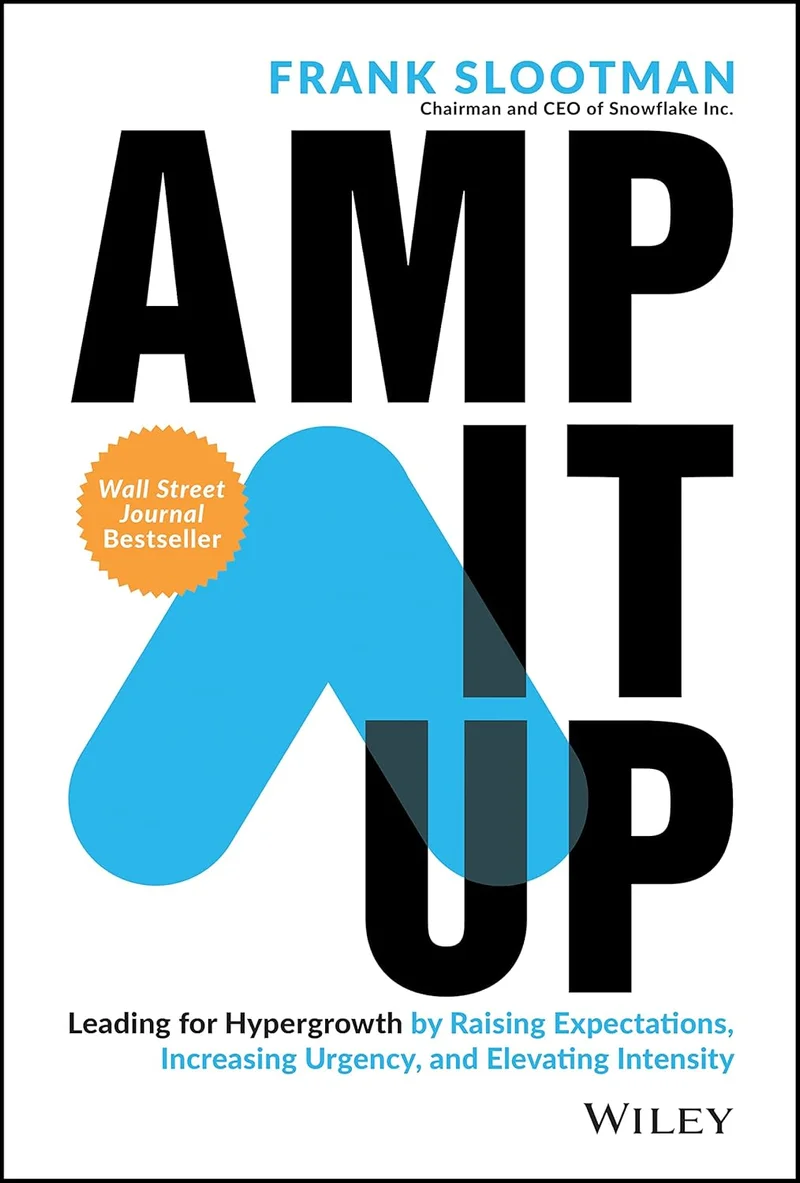
Why This Book Matters for Scale-Up Leaders
Frank Slootman is one of the most accomplished operators in the technology world. He has led three companies through extraordinary growth journeys. At Data Domain, he scaled the business to a multi-billion-dollar acquisition by EMC. At ServiceNow, he helped transform the company into one of the most important enterprise software platforms. At Snowflake, he guided one of the most successful IPOs in software history. Each of these stories demonstrates his ability to take a promising organisation and accelerate it to industry leadership.
In Amp It Up, Slootman distills his leadership philosophy into a direct call to action. He argues that the difference between companies that plateau and companies that dominate is intensity. His core message is that leaders must raise standards, drive urgency, and simplify relentlessly. This is not a book about frameworks or templates. It is about mindset.
For founders of scale-ups, the book matters because rapid growth is not only an operational challenge. It is a psychological one. Growth requires leaders to change the organisation’s metabolism. The pace of decision-making must accelerate. The level of expectation must rise. The tolerance for mediocrity must shrink. Without these shifts, scale-ups lose momentum and are overtaken by competitors.
In Amp It Up, Slootman distills his leadership philosophy into a direct call to action. He argues that the difference between companies that plateau and companies that dominate is intensity. His core message is that leaders must raise standards, drive urgency, and simplify relentlessly. This is not a book about frameworks or templates. It is about mindset.
For founders of scale-ups, the book matters because rapid growth is not only an operational challenge. It is a psychological one. Growth requires leaders to change the organisation’s metabolism. The pace of decision-making must accelerate. The level of expectation must rise. The tolerance for mediocrity must shrink. Without these shifts, scale-ups lose momentum and are overtaken by competitors.
Key Insights
Raising standards is non-negotiable
Slootman is unequivocal: mediocrity is the enemy of scale. He believes that many companies fail not because they lack opportunity but because they tolerate average performance. Raising standards means demanding excellence in hiring, execution, and outcomes. For example, at Snowflake he insisted that the company only hire people who could raise the talent bar, not just fill roles. By holding the line on quality, the overall level of the organisation improved rather than diluted as headcount grew.
Urgency is a competitive advantage
In fast-moving markets, speed is often the only edge. Slootman emphasises that companies must act with urgency in everything they do. Decisions should be made quickly and progress should be prioritised over perfection. He often cut through slow consensus-building by making the call himself and insisting the company move forward. He believed that a fast decision with a chance of being corrected later was far better than a slow decision that killed momentum.
Focus creates impact
Scale-ups are often tempted to pursue every opportunity. This dilutes energy and produces mediocre results. Slootman insists that leaders must focus on a handful of priorities that matter most. He pushed his companies to identify the few critical initiatives that would drive the most impact and to align all resources around them. Focus requires discipline. It means saying no often and resisting the urge to chase every new idea.
Simplicity drives clarity
As companies grow, complexity creeps in. Processes multiply, layers of approval appear, and communication becomes fragmented. Slootman’s philosophy is to simplify relentlessly. He removed unnecessary steps, cut bureaucracy, and clarified responsibilities. For him, complexity is the enemy of execution. By simplifying, leaders create clarity that allows teams to move faster and more confidently.
Decisiveness over consensus
Slootman does not believe in leadership by committee. He acknowledges that consensus feels comfortable, but it produces diluted decisions and delays. In his view, the leader’s job is to decide, own the consequences, and move forward. Decisiveness creates momentum and clarity, while consensus often breeds hesitation and confusion.
Intensity defines culture
Slootman believes that intensity is contagious. When leaders show urgency, discipline, and passion, those qualities cascade throughout the organisation. Culture is not built by slogans but by the energy and expectations leaders project every day. If leaders operate slowly and tolerate mediocrity, that behaviour will spread. If they set a high bar and operate with urgency, the culture will rise to meet them.
Actionable Insights for Founders and Scale-Up Leaders
Examine where you are tolerating mediocrity
Audit your team, your product, and your processes. Ask yourself where you are settling for “good enough.” If you would not fight to keep someone on your team, why are they still in the role? If you would not buy your own product at the current quality level, why are you shipping it? Mediocrity spreads quickly. Eliminate it wherever you find it.
Drive urgency in every aspect of execution
Decisions that take weeks should take days. Projects that take months should be completed in weeks. Create shorter deadlines, enforce faster cycles, and insist on momentum. Teach teams that shipping something imperfect but on time is better than missing opportunities while chasing perfection.
Simplify priorities and goals
Reduce the number of strategic priorities to three or fewer for each quarter. Make them visible to the entire company and repeat them often. Remove or postpone projects that do not directly advance these priorities. Energy focused in a few directions produces breakthroughs. Energy spread across too many produces mediocrity.
Cut complexity before it strangles growth
Review processes and ask if each step adds value. Eliminate rules that slow execution. Empower teams with principles rather than procedures. As organisations grow, complexity creeps in silently. Leaders must actively remove it.
Be decisive even when uncomfortable
Do not wait for consensus when urgency matters. Make the best call you can with the information available, and commit to it. Be willing to adjust later if new data emerges. Teams need clarity more than they need perfection.
Model intensity at the top
Your behaviour as a leader sets the tone for the company. If you act with urgency, clarity, and discipline, your teams will too. If you slow down, tolerate excuses, or hedge on decisions, your teams will follow that example. Intensity is a cultural force, and it begins with you.
Practical Checklist Inspired by the Book
1Identify one area in your company where you are currently tolerating mediocrity and take decisive action to raise the bar.
2Review your decision-making cycle times and set a goal to cut them in half.
3Define three company-wide priorities for the next quarter and communicate them repeatedly until everyone can recite them.
4Remove one process, approval, or policy that adds complexity but not value.
5As a leader, demonstrate urgency this week by making a visible, decisive call on an issue that has been lingering.
6Publicly recognise an example of intensity in your team to reinforce the behaviour you want to spread.
Conclusion
Amp It Up is not a subtle book. Frank Slootman’s leadership philosophy is blunt, demanding, and uncompromising. Some may find it abrasive, but its power lies in its clarity. Growth requires intensity. Leaders must raise standards, act with urgency, simplify relentlessly, and refuse to tolerate mediocrity.
For scale-up leaders, this message is both challenging and empowering. It is challenging because it forces you to confront where you are slowing down, where you are tolerating average performance, and where you are chasing too many distractions. It is empowering because it reminds you that culture is not something abstract. It is the sum of the behaviours and energy you project every day.
The enduring lesson is that scale is not achieved by being comfortable. It is achieved by demanding more of yourself and your teams, moving faster than competitors, and amplifying intensity throughout the organisation. Companies that learn to “amp it up” are the ones that turn momentum into market leadership.
For scale-up leaders, this message is both challenging and empowering. It is challenging because it forces you to confront where you are slowing down, where you are tolerating average performance, and where you are chasing too many distractions. It is empowering because it reminds you that culture is not something abstract. It is the sum of the behaviours and energy you project every day.
The enduring lesson is that scale is not achieved by being comfortable. It is achieved by demanding more of yourself and your teams, moving faster than competitors, and amplifying intensity throughout the organisation. Companies that learn to “amp it up” are the ones that turn momentum into market leadership.