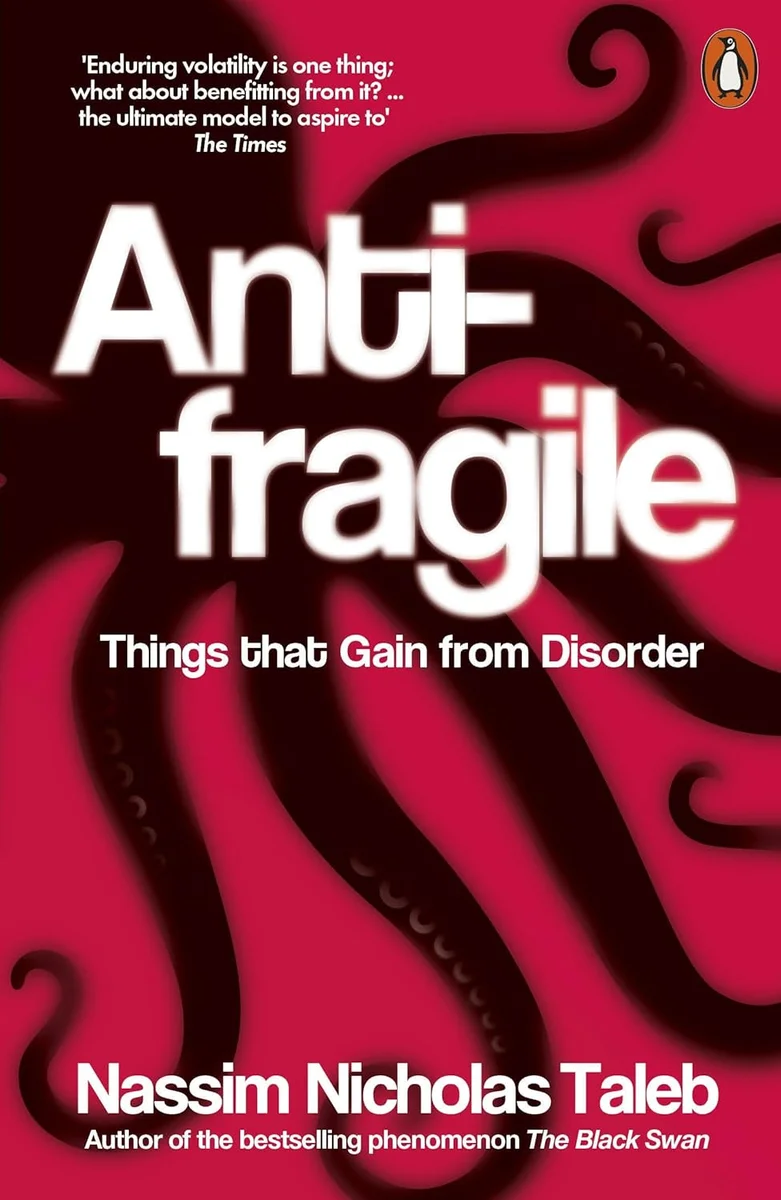
Why This Book Matters for Scale-Up Leaders
Most business leaders focus on making their organisations robust. They want to resist shocks, minimise volatility, and protect against disruption. Nassim Nicholas Taleb argues that this mindset is incomplete. Robust systems survive stress, but they do not improve because of it. Antifragile systems are different. They get stronger when they are exposed to shocks, randomness, and volatility.
In Antifragile, Taleb introduces this concept as the opposite of fragility. A fragile system breaks under stress. A robust system resists stress. An antifragile system improves because of stress. Nature is the clearest example. Bones get stronger when exposed to stress. Evolution adapts species to changing conditions. Human progress itself is the result of trial, error, and adaptation.
For founders of scale-ups, this book is critical because growth is never smooth. Markets shift unexpectedly, competitors move aggressively, and internal processes break as the company expands. The instinct is often to eliminate uncertainty and volatility. Taleb’s message is to embrace it, design systems that benefit from it, and avoid the illusion of stability.
In Antifragile, Taleb introduces this concept as the opposite of fragility. A fragile system breaks under stress. A robust system resists stress. An antifragile system improves because of stress. Nature is the clearest example. Bones get stronger when exposed to stress. Evolution adapts species to changing conditions. Human progress itself is the result of trial, error, and adaptation.
For founders of scale-ups, this book is critical because growth is never smooth. Markets shift unexpectedly, competitors move aggressively, and internal processes break as the company expands. The instinct is often to eliminate uncertainty and volatility. Taleb’s message is to embrace it, design systems that benefit from it, and avoid the illusion of stability.
Key Insights
Fragile, robust, and antifragile
Taleb distinguishes between three categories. Fragile things break when stressed, like glass. Robust things resist stress, like steel. Antifragile things actually improve with stress, like muscle. The goal of leadership is not only to avoid fragility but to cultivate antifragility.
Small experiments over grand plans
Antifragile systems evolve by trying many small variations and learning quickly from the results. Nature does not rely on central planning but on constant experimentation. In business, this means encouraging small bets, prototypes, and pilot projects rather than relying on top-down master plans.
Optionality as a source of strength
Antifragile systems thrive when they have options. The more optionality you have, the more you can take advantage of randomness. Start-ups often outperform incumbents because they have more options and fewer constraints. Leaders should design organisations that maintain flexibility, rather than locking into rigid commitments too early.
The barbell strategy
Taleb introduces the idea of the barbell strategy. This means combining extreme caution with extreme aggression. For example, you protect the downside by ensuring survival while simultaneously placing bold bets that have huge upside. This balance avoids catastrophic failure while maximising opportunities.
Skin in the game
True antifragility requires accountability. Systems become fragile when decision-makers do not bear the consequences of their actions. By ensuring that leaders and teams have skin in the game, organisations align incentives and make better, more sustainable decisions.
Overreliance on forecasts creates fragility
Taleb criticises the obsession with predicting the future. He argues that forecasts are often unreliable and give a false sense of control. Instead of trying to predict shocks, leaders should build systems that can adapt to shocks and even benefit from them.
Actionable Insights for Founders and Scale-Up Leaders
Encourage small-scale experimentation
Rather than betting everything on one strategy, create a portfolio of small experiments. Test new markets, features, and business models in low-risk ways. Allow the best ideas to emerge from trial and error.
Preserve flexibility and optionality
Avoid locking the company into rigid long-term commitments too early. Maintain financial flexibility, product adaptability, and strategic options. Flexibility gives you the ability to seize unexpected opportunities and survive unexpected shocks.
Adopt a barbell approach to risk
Protect the core of your business with conservative financial practices and strong fundamentals. At the same time, invest aggressively in bold bets that could create breakthrough growth. This dual approach ensures survival while keeping upside open.
Embed accountability through skin in the game
Align incentives so that leaders and employees share in both upside and downside outcomes. This may mean tying compensation to long-term results rather than short-term metrics. Skin in the game encourages better decision-making and reduces moral hazard.
Design learning systems rather than control systems
Instead of trying to eliminate volatility, design processes that learn from it. For example, implement post-mortems after failures, encourage candid reflection, and reward teams that take intelligent risks even if the outcome is not successful.
Reduce dependence on prediction
Do not spend excessive time creating precise forecasts. Accept that uncertainty is inherent and unpredictable events will happen. Build resilience and adaptability instead of relying on being right about the future.
Practical Checklist Inspired by the Book
1Identify three small experiments you can run in the next quarter to test new ideas with limited downside.
2Review your financial structure to ensure you have enough reserves or cash flow flexibility to weather unexpected shocks.
3Apply a barbell approach by protecting the company’s core operations while funding one or two bold bets with high potential upside.
4Align leadership incentives with long-term results to ensure true skin in the game.
5Replace one forecast-driven process with a learning-driven process, such as shifting from detailed prediction to rapid iteration.
6Create a culture that celebrates smart risks and learns openly from failures.
Conclusion
Antifragile is not a conventional business book. It is philosophical, provocative, and sometimes combative. Yet its insights are essential for scale-up leaders. Growth is turbulent by nature. The leaders who try to suppress volatility often create hidden fragility that reveals itself at the worst moments.
Taleb’s message is to design organisations that get stronger from stress. By experimenting constantly, preserving flexibility, embracing optionality, and embedding accountability, leaders can create companies that not only survive shocks but thrive because of them.
The enduring lesson is that resilience is not enough. In a world of uncertainty, the most successful organisations are those that benefit from randomness. By embracing antifragility, scale-ups can turn volatility from a threat into a source of strength.
Taleb’s message is to design organisations that get stronger from stress. By experimenting constantly, preserving flexibility, embracing optionality, and embedding accountability, leaders can create companies that not only survive shocks but thrive because of them.
The enduring lesson is that resilience is not enough. In a world of uncertainty, the most successful organisations are those that benefit from randomness. By embracing antifragility, scale-ups can turn volatility from a threat into a source of strength.