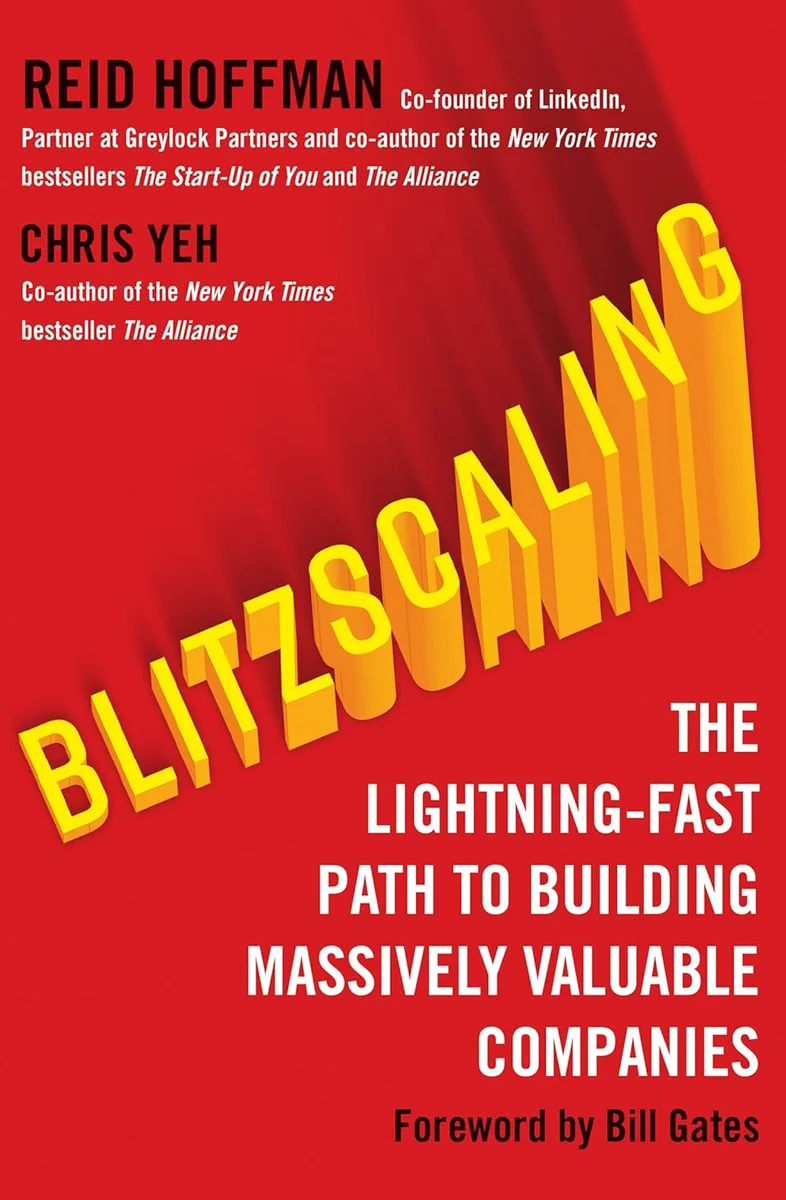
Why This Book Matters for Scale-Up Leaders
Most scale-ups dream of rapid growth, but very few understand what it takes to achieve it. Reid Hoffman, co-founder of LinkedIn, and Chris Yeh, an entrepreneur and investor, wrote Blitzscaling to explain how certain companies achieve hypergrowth and why they are willing to take risks that would seem reckless to traditional managers.
Blitzscaling is the practice of prioritising speed over efficiency in an environment of uncertainty. The goal is to capture massive markets quickly before competitors can respond. The authors argue that in networked industries where winner-takes-most dynamics dominate, speed of scaling can be the decisive factor that determines category leadership.
For scale-up leaders, this book matters because it forces a choice. Do you want to grow steadily and carefully, or do you want to aim for category dominance by moving at breakneck speed, accepting inefficiencies and risks in the process?
Blitzscaling is the practice of prioritising speed over efficiency in an environment of uncertainty. The goal is to capture massive markets quickly before competitors can respond. The authors argue that in networked industries where winner-takes-most dynamics dominate, speed of scaling can be the decisive factor that determines category leadership.
For scale-up leaders, this book matters because it forces a choice. Do you want to grow steadily and carefully, or do you want to aim for category dominance by moving at breakneck speed, accepting inefficiencies and risks in the process?
Key Insights
Blitzscaling is prioritising speed over efficiency
Traditional business thinking focuses on efficiency. Blitzscaling flips this logic. The goal is to move so fast that you dominate the market, even if the process is messy and wasteful. Efficiency can be optimised later, but market leadership is won now.
Winner-takes-most markets reward speed
In many modern industries, particularly technology, markets tend to consolidate around one or two leaders. Network effects, economies of scale, and brand recognition mean that the fastest scaler often wins disproportionately.
Growth creates chaos, but chaos is acceptable
Blitzscaling acknowledges that rapid growth creates broken processes, stressed systems, and constant firefighting. The philosophy is to accept this chaos as the price of outpacing competitors.
The stages of growth
Hoffman and Yeh describe five stages: family, tribe, village, city, and nation. Each stage requires different management structures and leadership skills. What works at one stage will break at the next. Leaders must evolve rapidly as the company grows.
Counterintuitive rules
Blitzscaling requires counterintuitive decisions, such as hiring people before you need them, prioritising speed over quality, or scaling operations that are not yet fully proven. These decisions seem irrational but are necessary when speed is paramount.
Risks of blitzscaling
The authors acknowledge that blitzscaling is dangerous. It can lead to financial overreach, cultural breakdown, or catastrophic failures if executed poorly. It is not appropriate for every company or every market.
Actionable Insights for Founders and Scale-Up Leaders
Assess whether blitzscaling is necessary
Not every company should blitzscale. Ask whether your market has winner-takes-most dynamics. If the market rewards speed, then blitzscaling may be necessary. If not, growing sustainably may be the wiser path.
Be willing to sacrifice efficiency for speed
Accept that blitzscaling will produce inefficiencies. You may hire people faster than you can onboard them, launch products before they are perfect, and build systems that will later need to be rebuilt. The priority is speed.
Plan for stages of growth
Understand which stage your company is in and anticipate the leadership and organisational changes required for the next stage. Do not cling to old processes that will break at scale.
Invest ahead of demand
Hire and build capacity before you need it. Blitzscaling requires that you stay ahead of growth, even if it creates temporary inefficiency.
Secure funding aggressively
Hypergrowth consumes massive amounts of capital. Be prepared to raise significant funding to sustain the pace. Blitzscaling without adequate resources is a recipe for collapse.
Prepare for cultural strain
Rapid hiring and growth put enormous pressure on culture. Leaders must reinforce values continuously and make difficult decisions to protect cultural integrity.
Know when to stop blitzscaling
Blitzscaling is not permanent. Once market leadership is secured, the focus must shift back to efficiency, sustainability, and profitability. Leaders must recognise when it is time to change gears.
Practical Checklist Inspired by the Book
1Analyse whether your industry is winner-takes-most and whether blitzscaling is necessary to win.
2Identify the stage of growth you are in and the changes needed to transition to the next stage.
3Set priorities for speed over efficiency in one key area, such as hiring, product launch, or customer acquisition.
4Build a financial plan that secures the capital required to sustain hypergrowth.
5Create mechanisms to reinforce company culture during rapid hiring and expansion.
6Establish clear criteria for when to transition from blitzscaling to sustainable scaling.
Conclusion
Blitzscaling is a controversial book because it challenges traditional wisdom about building companies carefully and efficiently. It argues that in certain markets, the only path to leadership is to grow faster than anyone else, even if it means breaking things along the way.
For scale-up leaders, the book’s lesson is not that blitzscaling is always the right path. It is that in winner-takes-most markets, speed itself can be the decisive advantage. Choosing not to move fast may mean choosing not to win.
The enduring message is that leaders must understand their market dynamics and choose consciously. Blitzscaling is a powerful but dangerous tool. Used in the right context, it can create category kings. Used in the wrong context, it can destroy promising companies.
For scale-up leaders, the book’s lesson is not that blitzscaling is always the right path. It is that in winner-takes-most markets, speed itself can be the decisive advantage. Choosing not to move fast may mean choosing not to win.
The enduring message is that leaders must understand their market dynamics and choose consciously. Blitzscaling is a powerful but dangerous tool. Used in the right context, it can create category kings. Used in the wrong context, it can destroy promising companies.